Showing posts with label Easter Rising 1916. Show all posts

Thursday, 13 October 2022

New Books and Titles | The Dawning of the Day by Liam Nevin

The Dawning of the Day by Liam Nevin

– sweeping-epic family drama set against background of a turbulent decade in Irish history –
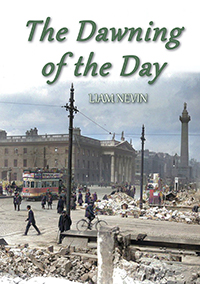
Front cover of The Dawning of the Day by Liam Nevin featuring a scene from Dublin's O'Connell Street in the immediate aftermath of the Easter Rising of 1912

As Ireland's Decade of Centenaries draws to a close, a recently published historical novel by Liam Nevin recounts that turbulent period in a sweeping epic of interweaving tales concerning three families, their trials and tribulations, their lives and loves.

The Brennans are a working-class family from Dublin's inner city. In 1915, John Brennan enlists in the British Army, where he experiences the horrors of war first hand.

In nearby rural County Kildare (but almost a world away) are the Byrnes, a family of farm labourers who work for Major O'Kelly, a wealthy landowner of Irish Ascendancy descent.

Events that are about to unfold will change everything – forever and for all concerned.

The genesis of this book, Liam Nevin recalls, lies in a story that his mother used to relate to him as a young boy, of a soldier being fatally wounded in a field that they would pass on their Sunday walks. The incident occurred during Ireland's civil war (1922-23) and, it stoked an interest in him that he would often return to.

I never remembered being taught much about that time when I was at school in the sixties. It was probably too painful or too embarrassing for those who lived through it. Most history books went only as far as the Anglo-Irish War, when Ireland had 'won her freedom'. I remember the enmity that existed between neighbours when I was growing up in the fifties and sixties. I struggled to understand why some families were for and others against the Treaty of 1921. My research would lead me to the answer.

The 1913 Lockout, the Great War, the Easter Rising of 1916, the Irish War of Independence and subsequent civil war all come within the scope of this narrative. Faithful attention to historical detail adds to its allure. However, it is the impact of these events on the human level (the individual and interpersonal tales) that offer up a rich seam of storytelling.

A native of County Kildare, Liam Nevin lives in Shepperton, England with his wife Marlene, where he is now retired, having worked for forty-one years at Heathrow Airport. He writes on Irish and local history, in both fictional and non-fictional styles.

The Dawning of the Day by Liam Nevin is published by The Manuscript Publisher and available to buy online, in print and e-book editions. Previously published works by Liam Nevin include The Tobacco Fields of Meath (2010) and Brightening Over Dillon's (2016), which are also available to buy online.

Hear Liam Nevin speak to Theresa Quinn of Liffey Sound FM about his books and writing activities

Monday, 31 July 2017

Francis Ledwidge (1887-1917): Ireland's War Poet

"He has left behind him verses of great beauty, simple rural lyrics that may be something of an anodyne for this stricken age. If ever an age needed beautiful little songs our age needs them." – Lord Dunsany from the Introduction to Last Songs by Francis Ledwidge

Frontispiece, The Complete Poems of Francis Ledwidge, 1919
By Francis Ledwidge
[Public domain], via Wikimedia Commons
On this day in 1917, soldiers from the Royal Inniskilling Fusiliers (an Irish line infantry regiment of the British Army) were taking a break from road-laying preparations that were being undertaken near Boezinge, a village north of the city of Ypres in West Flanders, Belgium. It was part of a planned assault during the Battle of Passchendaele (also known as the Third Battle of Ypres). A shell exploded nearby killing six members of the regiment. One of them was Francis Ledwidge (b. 1887) from Slane, Co. Meath.

It might have been regarded as just another tragic statistic in a conflict that took the lives of millions (including 50,000 Irishmen). However, the legacy arising from the casualty of Ledwidge's death has endured down through the years. He was already a published poet in his own short lifetime. His death gained him the stature of Ireland's war poet, although he is also recalled as the 'poet of the blackbirds'.

Francis Ledwidge was born into circumstances that are generally described as poverty stricken. With his father dying prematurely (when Francis was only five) he was forced, like many before and after him, to find work at an early age – as a farm labourer, in road construction (poignant given the circumstances of his death), as a miner (where he was sacked for organising a strike), trade union activist and shop assistant.

Although his formal education ended when he was 13, it seems that he continued to educate himself, whenever and wherever he could – it is said that he could even be observed writing on gates or fence posts. From the age of 14, his poems began to be published in a local newspaper, the Drogheda Independent.

Eventually, his work came to the attention of Lord Dunsany, who resided in the same Co. Meath locality that Ledwidge wrote about with such passionate intensity.
"... like a mountain sheer out of marshes, that easy fluency of shapely lines which is now so noticeable in all that he writes; that and sudden glimpses of the fields that he seems at times to bring so near to one that one exclaims, "Why that is how Meath looks," or "It is just like that along the Boyne in April," quite taken by surprise by familiar things: for none of us knows, till the poets point them out, how many beautiful things are close about us." – Lord Dunsany, from the Introduction to Songs of the Field by Francis Ledwidge

Dunsany was considered, at the time, to be "one of the greatest living writers of the English-speaking world" according to Wikipedia. His patronage not only helped Ledwidge to get his first volume of poetry published (Songs of the Fields appeared in 1915, a copy reaching Ledwidge while his unit was marching through Serbia, following the Battle of Gallipoli); it also introduced him to literary circles that included W.B. Yeats and other prominent figures in the Irish Literary Revival.
Francis Ledwidge memorial
Memorial to Francis Ledwidge
on the sport where he died.
By David Edgar (Own work)
[CC BY-SA 3.0 or GFDL],
via Wikimedia Commons

Participation in World War I is one of those enigmas that surrounds Ledwidge. Like others among the war poets of that time, he was no doubt motivated by a keen sense of patriotism and nationalism. However, Ledwidge's attitude towards the war reflected the ambiguity that many of his countrymen felt: one that was as much as odds with the British Empire as it was with German ambitions. He initially opposed John Redmond's call for Irish Volunteers (Ledwidge was a founder member of the Slane branch) to enlist in Irish regiments and support the British war effort. His views were probably much closer to the minority group within the Irish Volunteers, who would go on to play a leading role in the Easter Rising of 1916. In the aftermath of the Rising, Ledwidge expressed views in support of the insurgents that led to his being court-marshalled.
Lament for Thomas MacDonagh
by Francis Ledwidge
He shall not hear the bittern cry
In the wild sky, where he is lain,
Nor voices of the sweeter birds,
Above the wailing of the rain.
Nor shall he know when loud March blows
Thro’ slanting snows her fanfare shrill,
Blowing to flame the golden cup
Of many an upset daffodil.
But when the Dark Cow leaves the moor,
And pastures poor with greedy weeds,
Perhaps he’ll hear her low at morn,
Lifting her horn in pleasant meads.

Subsequent to his death, two further volumes of poetry appeared. Songs of Peace was in preparation when Ledwidge died and after the war, Dunsany arranged for more of Ledwidge's work to be published in a third and final volume, Last Songs.

His reputation has grown in the years that have followed. His family homestead in Slane was acquired in 1978 and a Francis Ledwidge Museum was opened there in 1982.
Oh what a pleasant world 'twould be,
How easy we'd step thro' it,
If all the fools who meant no harm,
Could manage not to do it!
– Francis Ledwidge (1887-1917)


Sources:


Monday, 24 April 2017

Birth of a Nation: the literary men and women of 1916

On the 101st anniversary of Ireland's Easter Rising of 1916, the flowering of Irish literary talent in the late 19th and early 20th century (often referred to as the Irish Literary Revival) is considered for the influence that it exerted upon a generation of Irishmen and women who helped to forge the destiny of a nation.


Sunday, 24 April 2016

The Literary Legacy of Ireland's Easter Rising, 1916

A Poets' Rebellion?

Often described and occasionally dismissed as a poets' rebellion, the Easter Rising of 1916 was, nevertheless, an event that had far-reaching significance. We are reproducing here, an article from Dublin Made Me website, which attempts to put it in a historical context while also alluding to the literary impact of those events that took place 100 years ago today.

On this day in 1916, precisely 100 years ago, an armed insurrection broke out on the streets of Dublin, heralding the start of what was originally dubbed the Sinn Féin Rebellion but would come to be known as the Easter Rising.

A week of heavy fighting ensued. The rising was eventually quashed by the superior military power of British armed forces, although strategic failures on the part of the rebels and, indeed, bad luck also played a part in ensuring the outcome. Nevertheless, while often dismissed as a military failure (or even a 'heroic failure'), the fact remains that, aside from the General Post Office, which served as the Rising's headquarters, no other rebel position fell until the order to surrender was received. Thus, while the order for unconditional surrender was issued on Saturday, 29 April (by Padraig Pearse, co-signed by James Connolly) fighting continued until the following day, as it took time for the surrender order to filter through to certain rebel strongholds.

Birth of the Irish Republic
Walter Paget [Public domain], via Wikimedia Commons

The immediate public reaction to the Rising was one of bewilderment, confusion, even outright hostility. Yet, as events proceeded, the mood changed, almost as the leaders of the Rising had predicted it would. The words of a contemporary observer, William Butler Yeats, are often cited to convey the sense of ambiguity but also foreboding that followed in the immediate aftermath:

All changed, changed utterly:
A terrible beauty is born.

- from Easter 1916 by W.B. Yeats, September 25, 1916
Whatever Yeats' may have had in mind about the 'change' and the 'terrible beauty' it had given birth to, in hindsight and at this juncture, we have the opportunity to see, in a more fully fledged form, just what the leaders of the Rising were driving towards. As Yeat's alludes, it was not so much the Rising itself but the aftermath and the series of event that was set in motion, initiating and making inevitable broad, sweeping, wholesale changes in the conduct of affairs between people and nations of the earth.
The Easter Rising was, arguably a catalyst for all of this. It marked the opening salvo that ushered in a new era, as the age of empire began its long, slow retreat, to be replaced by a new age of democracy based national sovereignty, backed up by universal suffrage and government based on popular rule. An age of international co-operation based on the free association of free people and nations.

All of this is presaged by the Rising's manifesto, as proclaimed on the steps of the GPO on this day in 1916. It is those words that ring clear today, just as they resonated with people at the time. The Proclamation of the Irish Republic is a literary masterpiece in its own right, not just of its time but for all time.

Easter Proclamation of 1916
By originally uploaded to the English Wikipedia by w:User:Jtdirl
[Public domain], via Wikimedia Commons

'via Blog this'


Dublin Made Me is a website that celebrates Dublin, Ireland's capital city, "as it has been immortalised down through the years, in music, literature, art and stuff".

Search This Site

Popular Posts

Calendar – Dates for Your Diary