Showing posts with label Irish history. Show all posts

Tuesday, 24 January 2023

Book Launch | Customs House to Howth Head by Dennis McIntyre

Customs House to Howth Head

– A History and Guide to the Dublin North Bay Area by Dennis McIntyre –
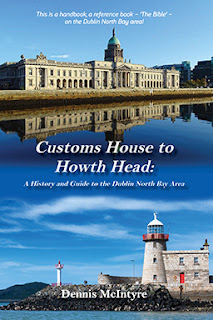
Front cover of Customs House to Howth Head by Dennis McIntyre
Customs House to Howth Head by Dennis McIntyre

A newly published historical account of Dublin's North Bay area will be formally launched on Wednesday, 1 February at Clontarf Castle Hotel, Castle Avenue, Clontarf, starting at 8pm.

Customs House to Howth Head: A History and Guide to the Dublin North Bay Area is author, Dennis McIntyre’s latest contribution to Irish, local, social and cultural history. The trek – from the stately Customs House in the city centre to the wild and charming Howth Head – is documented in all its facets, angles and aspects. Exhaustively researched, the book comes across as both informative and entertaining, in addition to being copiously illustrated with a well-chosen selection of images.

Dennis McIntyre is the previously published author of Meadow of the Bull: A History of Clontarf (1987) and has also written about other aspects of Irish history, such as in Bram Stoker and the Irishness of Dracula (2013) and Irish Nationalism, Irish Republicanism and the 1916 Easter Rising (2016).

This is not just a local history but rather, a series of local histories, covering Dublin's Customs House and Docklands areas, North Strand, Summerhill, Ballybough, Fairview, Marino, Donnycarney, Clontarf, Killester, Raheny, Kilbarrack, Bayside, Donaghmede, Baldoyle, Sutton and Howth. It has everything that local history should have – and that bit extra.

Customs House to Howth Head: A History and Guide to the Dublin North Bay Area is published by Shara Press. It is available to buy online (RRP €19.99). It will also be on sale at the launch at Clontarf Castle Hotel on 1 February, where the author will be on hand to sign copies. Joe Harrington of Sunshine Radio will provide the keynote address while Ciaran Murphy, of Near FM radio, will perform the introductions.

Dennis McIntyre is an author, historian, tour guide, broadcaster and former teacher. Originally from Sligo, he has lived on the northside of Dublin for a number of years and he has established a reputation as a local historian. In addition to his writing, Dennis McIntyre also serves as founder and director of Dublin North Bay Tourism and the Stoker Dracula Gothic Organisation. Previously published works are also available to buy online.

Thursday, 13 October 2022

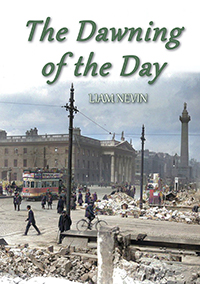
New Books and Titles | The Dawning of the Day by Liam Nevin

The Dawning of the Day by Liam Nevin

– sweeping-epic family drama set against background of a turbulent decade in Irish history –

Front cover of The Dawning of the Day by Liam Nevin featuring a scene from Dublin's O'Connell Street in the immediate aftermath of the Easter Rising of 1912

As Ireland's Decade of Centenaries draws to a close, a recently published historical novel by Liam Nevin recounts that turbulent period in a sweeping epic of interweaving tales concerning three families, their trials and tribulations, their lives and loves.

The Brennans are a working-class family from Dublin's inner city. In 1915, John Brennan enlists in the British Army, where he experiences the horrors of war first hand.

In nearby rural County Kildare (but almost a world away) are the Byrnes, a family of farm labourers who work for Major O'Kelly, a wealthy landowner of Irish Ascendancy descent.

Events that are about to unfold will change everything – forever and for all concerned.

The genesis of this book, Liam Nevin recalls, lies in a story that his mother used to relate to him as a young boy, of a soldier being fatally wounded in a field that they would pass on their Sunday walks. The incident occurred during Ireland's civil war (1922-23) and, it stoked an interest in him that he would often return to.

I never remembered being taught much about that time when I was at school in the sixties. It was probably too painful or too embarrassing for those who lived through it. Most history books went only as far as the Anglo-Irish War, when Ireland had 'won her freedom'. I remember the enmity that existed between neighbours when I was growing up in the fifties and sixties. I struggled to understand why some families were for and others against the Treaty of 1921. My research would lead me to the answer.

The 1913 Lockout, the Great War, the Easter Rising of 1916, the Irish War of Independence and subsequent civil war all come within the scope of this narrative. Faithful attention to historical detail adds to its allure. However, it is the impact of these events on the human level (the individual and interpersonal tales) that offer up a rich seam of storytelling.

A native of County Kildare, Liam Nevin lives in Shepperton, England with his wife Marlene, where he is now retired, having worked for forty-one years at Heathrow Airport. He writes on Irish and local history, in both fictional and non-fictional styles.

The Dawning of the Day by Liam Nevin is published by The Manuscript Publisher and available to buy online, in print and e-book editions. Previously published works by Liam Nevin include The Tobacco Fields of Meath (2010) and Brightening Over Dillon's (2016), which are also available to buy online.
Hear Liam Nevin speak to Theresa Quinn of Liffey Sound FM about his books and writing activities

Tuesday, 30 April 2019

The Much-Maligned Mary Pike and Other Stories

Recently published, The Much-Maligned Mary Pike: The Rebel County and '98 by Kieran Groeger will feature at two events, in Waterford and in Cork, over the coming fortnight.

The Much-Maligned Mary Pike by Kieran Groeger (The Rebel County and '98)
The Much-Maligned Mary Pike
by Kieran Groeger
Mary Pike was a wealthy, young Quaker heiress who was kidnapped in July 1797 by a widowed knight, Sir Henry Brown Hayes, intent on forcing her into marriage and getting his hands on her fortune. She was rescued from his house, Vernon Mount, in Cork city.

He fled the country but, then deciding that public opinion was in his favour, he challenged her to face him in court. He was shocked when Mary Pike won the case and he was soon sentenced to transportation for life in Australia, where the governor was a certain Captain Bligh, lately of the Bounty.

Sadly, the history books tell us that the subsequent ordeal was too much for Mary Pike – she suffered a nervous breakdown and died in a mental hospital.

The author, Dr Kieran Groeger, delights in stripping away the layers of documentation, analysing legends, old newspaper accounts, piecing together the clues to reveal a truly astonishing story.

The 1798 Rebellion of the United Irishmen features as backdrop to these events. It may surprise people who ask, 'did nothing happen in Cork?' to learn that quite a lot took place during this period, as the city is brought to life in this much anticipated volume.

Kieran will be among the line-up for this coming Sunday, 5 May at Dromana House and Gardens, where where a day long programme on the theme of "In Pursuit of the Heiress" will be held. The event runs from 10.30am to 4pm, with breaks for lunch and afternoon tea. Other talks will be provided by Julian Walton, Judy Brittain and Dr. Dagmar O’Riain-Raedel. Enquires and bookings can be made through Dromana House and Gardens website.

On the following Friday, 10 May, the formal launch of The Much-Maligned Mary Pike will take place at the Crawford Art Gallery, Cork, starting 12.30am, where originals of illustrations featured in the book are on display. The event is hosted by Friends of Crawford Art Gallery and all are welcome to attend.

The Much-Maligned Mary Pike: The Rebel County and '98 by Kieran Groeger is published by The Manuscript Publisher and on sale now. It is available to buy online as well as in all good bookshops. RRP €14.99.

Kieran Groeger, author of The Trial and Execution of James Cotter, the Little Book of Youghal, along with other books and articles on Irish and local history, is a retired teacher, avid Francophile and regular cyclist.

Friday, 16 February 2018

Why Did They Lie? by Jack Kiernan. Shadowy Events of the Irish Civil War 1922-23

Why Did They Lie? by Jack Kiernan

– The Irish Civil War, The Truth, Where and When it all Began –


A new book about the Irish Civil War (1922-23) uncovers shadowy events that took place, shedding important light on the very origins of that conflict, where and when it began. It also offers an assessment that challenges certain assumptions about the course of events, the personalities and leadership dynamics involved.

Most people, with any knowledge of Irish history, know that hostilities in the Irish Civil War commenced with the move, by the Provisional Government, to take the Four Courts in Dublin (held by anti-Treaty forces) towards the end of June 1922. But, most people would be wrong! That is the view of Jack Kiernan, who sets out to investigate the roots of a tragic and bitter conflict, that proceeded apace with the emergence of independent Irish statehood.

Growing up in an Irish Midlands town, Jack Kiernan remembers being told by his teachers that "if anything of importance happened in Mullingar, it would have been recorded."

Bullet holes remnants in the walls of prominent local buildings seemed to give lie to these bland assertions, as did the recollections of older neighbours, alluding to "the shooting of unarmed prisoners during the Civil War."

What he only discovered, much later, was that events of, not just local but national significance had taken place in the town where he grew up. What's more, they had been recorded, only to be buried deep within the archives – almost as if they had been deliberately covered up!

The evidence that he reveals here, confirms that open hostilities between pro- and anti-treaty forces were already in place, throughout the country, early in 1922 and prior to the events in Dublin. Furthermore, gun battles took place in the town of Mullingar during the month of April 1922, resulting in deaths. Evidence also suggests that British forces, though officially withdrawn, may have fired the first shots.

The events of the Irish Civil War (1922-1923) have cast a long shadow over Irish life. This book sheds important light on a dark chapter in Irish history; a contribution towards the debate that surely must accompany the centenaries of these events, which are now just around the corner.

Why Did They Lie? by Jack Kiernan is published by The Manuscript Publisher and available to buy online, as well as from certain bookshops. For further information, visit the author's website.

Tuesday, 12 September 2017

Dublin: Two Poems, One City

On the occasion of the 110th anniversary of the birth of poet and playwright, Louis MacNeice (1907-1963) we are re-posting the following, which originally appeared on Dublin Made Me website in 2012.

Dublin and Dublin Made Me: Two Poems - MacDonagh and MacNeice:


We were contacted recently by Niall MacDonagh, son of Donagh MacDonagh, who had this to say about Dublin Made Me, the title of the poem which also serves as the name of this website:
I just need to record that it upsets me that, of all the poetry, plays, stories my father left behind, THAT piece of verse is what is remembered. The thing is that it is not about Dublin at all but a put down of the rest of the country. Read it and you will see what I am saying.

Now, if you want a very fine poem about Dublin (by a non Dubliner) see this:

Dublin

Grey brick upon brick,
Declamatory bronze
On sombre pedestals -
O'Connell, Grattan, Moore -
And the brewery tugs and the swans
On the balustraded stream
And the bare bones of a fanlight
Over a hungry door
And the air soft on the cheek
And porter running from the taps
With a head of yellow cream
And Nelson on his pillar
Watching his world collapse.
This never was my town,
I was not born or bred
Nor schooled here and she will not
Have me alive or dead
But yet she holds my mind
With her seedy elegance,
With her gentle veils of rain
And all her ghosts that walk
And all that hide behind
Her Georgian facades -
The catcalls and the pain,
The glamour of her squalor,
The bravado of her talk.
The lights jig in the river
With a concertina movement
And the sun comes up in the morning
Like barley-sugar on the water
And the mist on the Wicklow hills
Is close, as close
As the peasantry were to the landlord,
As the Irish to the Anglo-Irish,
As the killer is close one moment
To the man he kills,
Or as the moment itself
Is close to the next moment.
She is not an Irish town
And she is not English,
Historic with guns and vermin
And the cold renown
Of a fragment of Church latin,
Of an oratorical phrase.
But oh the days are soft,
Soft enough to forget
The lesson better learnt,
The bullet on the wet
Streets, the crooked deal,
The steel behind the laugh,
The Four Courts burnt.
Fort of the Dane,
Garrison of the Saxon,
Augustan capital
Of a Gaelic nation,
Appropriating all
The alien brought,
You give me time for thought
And by a juggler's trick
You poise the toppling hour -
O greyness run to flower,
Grey stone, grey water,
And brick upon grey brick.
– Louis MacNeice

A good point and well-taken. Grateful we are too, to be reminded of Louis MacNeice's sombre yet elegant paean to the city. Irish people of a certain generation will possibly recall being taught both MacNeice's and MacDonagh's poems as part of English curriculum.

Donagh MacDonaghDonagh MacDonagh (1912-1968) was an Irish writer, judge, presenter, broadcaster, and playwright. According to Wikipedia:
He wrote poetic dramas and ballad operas. He published three volumes of poetry: Veterans and Other Poems (1943), The Hungry Grass (1947) and A Warning to Conquerors (1969). He also edited the Oxford Book of Irish Verse (1958) with Lennox Robinson. A play, Happy As Larry, was translated into a number of languages. He had three other plays produced: God's Gentry (a ballad opera about the tinkers), Lady Spinder (about Deirdre of the Sorrows and the Three sons of Ussna and by far his best writing) and Step in the Hollow a piece of situation comedy nonsense. He also wrote short stories. He published Twenty Poems with Niall Sheridan; staged first Irish production of Murder in the Cathedral with Liam Redmond, later his brother-in-law. Furthermost he was a popular broadcaster on Radio Éireann.

His books are no longer in print but we understand that a project is underway to publish all of his writings, in e-book form, or at least those that can be found: it appears that he was a very prolific writer. Websites that contains links to his poems and plays can be found here and here. The National Library of Ireland also holds some of his personal letters and papers, in addition to those of his father, Thomas MacDonagh, also a poet and playwright, who was among the leaders of the 1916 Rising subsequently executed for his role, his name appearing as one of the signatories to the Proclamation of the Irish Republic.

Louis MacNeice was born in Belfast in 1907, to parents originally from the west of Ireland. It is recorded that when he was six, his mother was admitted to a Dublin nursing home suffering from severe depression and he did not see her again. Inauspicious beginnings you might say, to his relationship with a city that would inspire him to write those lines.

His first trip to Dublin appears to have been in 1934, when he met with William Butler Yeats. The poem, Dublin was written in 1939 and first appeared in a collection entitled The Last Ditch, which was published in 1940. The strength and endurance of the lines which he penned, are nowhere better exemplified than in this recital, given by a true Dubliner, albeit recorded on the streets of Galway, a city to be found amongst -
The raw and hungry hills of the West
The lean road flung over profitless bog
Where only a snipe could nest
Where the sea takes its tithe of every boat.
Bawneen and currach have no allegiance of mine


One can only wonder how words like "This never was my town ...and she will not have me alive or dead" must resonate in the heart of a homeless exile.


Reference Material:

Monday, 31 July 2017

Francis Ledwidge (1887-1917): Ireland's War Poet

"He has left behind him verses of great beauty, simple rural lyrics that may be something of an anodyne for this stricken age. If ever an age needed beautiful little songs our age needs them." – Lord Dunsany from the Introduction to Last Songs by Francis Ledwidge

Frontispiece, The Complete Poems of Francis Ledwidge, 1919
By Francis Ledwidge
[Public domain], via Wikimedia Commons
On this day in 1917, soldiers from the Royal Inniskilling Fusiliers (an Irish line infantry regiment of the British Army) were taking a break from road-laying preparations that were being undertaken near Boezinge, a village north of the city of Ypres in West Flanders, Belgium. It was part of a planned assault during the Battle of Passchendaele (also known as the Third Battle of Ypres). A shell exploded nearby killing six members of the regiment. One of them was Francis Ledwidge (b. 1887) from Slane, Co. Meath.

It might have been regarded as just another tragic statistic in a conflict that took the lives of millions (including 50,000 Irishmen). However, the legacy arising from the casualty of Ledwidge's death has endured down through the years. He was already a published poet in his own short lifetime. His death gained him the stature of Ireland's war poet, although he is also recalled as the 'poet of the blackbirds'.

Francis Ledwidge was born into circumstances that are generally described as poverty stricken. With his father dying prematurely (when Francis was only five) he was forced, like many before and after him, to find work at an early age – as a farm labourer, in road construction (poignant given the circumstances of his death), as a miner (where he was sacked for organising a strike), trade union activist and shop assistant.

Although his formal education ended when he was 13, it seems that he continued to educate himself, whenever and wherever he could – it is said that he could even be observed writing on gates or fence posts. From the age of 14, his poems began to be published in a local newspaper, the Drogheda Independent.

Eventually, his work came to the attention of Lord Dunsany, who resided in the same Co. Meath locality that Ledwidge wrote about with such passionate intensity.
"... like a mountain sheer out of marshes, that easy fluency of shapely lines which is now so noticeable in all that he writes; that and sudden glimpses of the fields that he seems at times to bring so near to one that one exclaims, "Why that is how Meath looks," or "It is just like that along the Boyne in April," quite taken by surprise by familiar things: for none of us knows, till the poets point them out, how many beautiful things are close about us." – Lord Dunsany, from the Introduction to Songs of the Field by Francis Ledwidge

Dunsany was considered, at the time, to be "one of the greatest living writers of the English-speaking world" according to Wikipedia. His patronage not only helped Ledwidge to get his first volume of poetry published (Songs of the Fields appeared in 1915, a copy reaching Ledwidge while his unit was marching through Serbia, following the Battle of Gallipoli); it also introduced him to literary circles that included W.B. Yeats and other prominent figures in the Irish Literary Revival.
Francis Ledwidge memorial
Memorial to Francis Ledwidge
on the sport where he died.
By David Edgar (Own work)
[CC BY-SA 3.0 or GFDL],
via Wikimedia Commons

Participation in World War I is one of those enigmas that surrounds Ledwidge. Like others among the war poets of that time, he was no doubt motivated by a keen sense of patriotism and nationalism. However, Ledwidge's attitude towards the war reflected the ambiguity that many of his countrymen felt: one that was as much as odds with the British Empire as it was with German ambitions. He initially opposed John Redmond's call for Irish Volunteers (Ledwidge was a founder member of the Slane branch) to enlist in Irish regiments and support the British war effort. His views were probably much closer to the minority group within the Irish Volunteers, who would go on to play a leading role in the Easter Rising of 1916. In the aftermath of the Rising, Ledwidge expressed views in support of the insurgents that led to his being court-marshalled.
Lament for Thomas MacDonagh
by Francis Ledwidge
He shall not hear the bittern cry
In the wild sky, where he is lain,
Nor voices of the sweeter birds,
Above the wailing of the rain.
Nor shall he know when loud March blows
Thro’ slanting snows her fanfare shrill,
Blowing to flame the golden cup
Of many an upset daffodil.
But when the Dark Cow leaves the moor,
And pastures poor with greedy weeds,
Perhaps he’ll hear her low at morn,
Lifting her horn in pleasant meads.

Subsequent to his death, two further volumes of poetry appeared. Songs of Peace was in preparation when Ledwidge died and after the war, Dunsany arranged for more of Ledwidge's work to be published in a third and final volume, Last Songs.

His reputation has grown in the years that have followed. His family homestead in Slane was acquired in 1978 and a Francis Ledwidge Museum was opened there in 1982.
Oh what a pleasant world 'twould be,
How easy we'd step thro' it,
If all the fools who meant no harm,
Could manage not to do it!
– Francis Ledwidge (1887-1917)


Sources:


Search This Site

Popular Posts

Calendar – Dates for Your Diary